Pages

Sunday, May 27, 2012

Little Bo Peep's Sheep (and Emus and Shorthorns) Wagga-ing Their Tails Behind Them--Day 6

Another cold morning in Australia found us drinking hot tea and shivering while we watched a presentation at Trigger Vale White Suffolk and Bond Merino Studs.

Andrew Bouffler shared with us the knowledge he gained while on his own study abroad trip years ago. He talked about the difference between performance and fitness and how breeding strictly for performance can kill fitness which kills profitability, thereby defeating the purpose of breeding for performance. I found it all quite interesting.  His daughter Ruby was running around with a baby lamb, Tom, trailing closely, but I agree with Graeme that a more appropriate name would have been Little Bo Peep.

 We reboarded the bus and drove through some desolate country to our next stop:  an emu farm in a town called The Rock in reference to a large mountain in the distance. The emus were quite entertaining. We learned that they have a mating season and the females are very territorial, so it was quite comical to watch them shoo each other away. Some were daring enough to fight for their spot, which is like nothing I've ever seen a bird do before.

We learned that when an emu is harvested, the best product is the 10 kilograms of oil which sells for $50/kilogram, making their herd of 200 worth $100,000 in oil alone, not including the other products:  meat, leather, feathers,  and eggs. Our hosts, Ian and Marilyn Marston, cooked lunch for us, which sadly was not emu, but grass-fed beef. Our final stop of the day was Spry's Shorthorn Stud. Gerald Spry took us around the small pens near the barn to show us some young bulls and a few cows. I was surprised to learn that one of the bulls we saw was valued at $46,000!

Then we got to get in out of the cold in the shed where he described his breeding program and another guy described the feedlot he manages that finishes Wagyu and Wagyu-cross cattle. We capped off this long day with a supper of grain-fed beef steaks that tasted like home.

Saturday, May 26, 2012

Seymour Cows--Day 5

First unofficial stop of the day:  McDonald's! First real stop of the day: Lawson Angus! This seedstock operation sells over 800 bulls every year.

Despite the rain and cold, Harry Lawson was kind enough to show us some nice young bulls and tell us about their multiple farms. It was also neat to hear about Harry's thoughts of their partnership with the Gardiner Angus Ranch; especially since we are accompanied by Grant Gardiner on this trip.

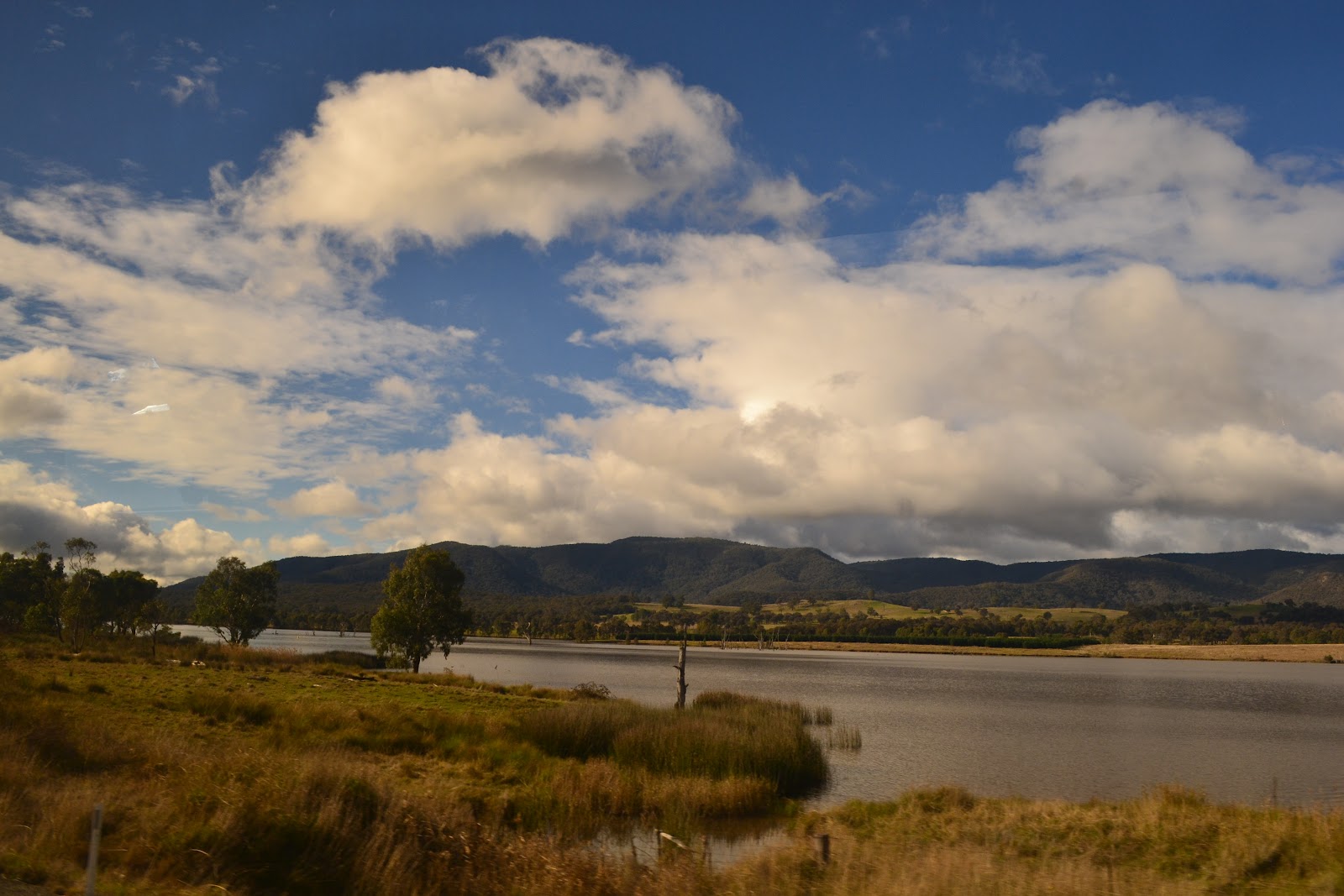
 After a quick stop at a coffee and wine shop, we made our way to Lima Park, driving past some beautiful scenery while snapping lots of pictures.

Lunch along the way was more of the same: fish and chips or chicken schnitzel (for the third time!). When we got to Lima, Hamish McMillan informed us about his operation of over 500 commercial Hereford cattle (he claims the ideal size of cow for him is 750-830 kilograms or 1600-1800 pounds) and 3000 sheep.

He talked about his experiences with NLIS (which were somewhat different than those we heard from the government's NLIS representative we heard from earlier this week) and their requirements for exporting to the European Union. Then we finished off our day with my favorite meal so far: creamy sweet chili linguini with prawns (shrimp).

Friday, May 25, 2012

More Acronyms and Adult Beverages--Day 4

I decided to start the morning off on an adventurous note with some Vegemite on toast.  We'd heard about it yesterday at CUB as a concentrated yeast byproduct from the brewing process. In fact, our tour guide highly recommended it, so how bad could it be? There are no words to describe the awful disgusting taste.  It's hard to imagine something that looks like smooth chocolate could taste so bad.  All I can say is that I would NEVER recommend it. Instead, I settled on some more blueberry muffins...much tastier!

Then we said a rainy goodbye to the Travelodge Southbank and headed to the JBS Abattoir. We donned white coats, rubber boots, earplugs, and some nice hairnets and headed in to the kill floor. We continued from there through the entire process right up to packaging of seasoned fresh meats that would be on shelves available to consumers the very next day--a very interesting sight, even if it was hard to hear anything our guide said to us through our earplugs and the noise from all the activity happening at once.

 The second visit of the day was to Webb Black Simmentals. Phillip Webb and Lynton Harrison greeted us with much gusto that spilled over the rest of our time there. Although it was still cold and rainy, we made a short visit to their barn to see some cattle and the ring where they hold an annual sale every March.

Then we hurried to the office where we warmed up with beer, chips, dip, and cookies. They entertained us with information about their stud, peppered with lots of stories and quips.

NLIS and CUB for LAG--Day 3

Thankfully, we got to sleep in this morning and I didn't feel too behind anymore. Our first visit today took us to see the Department of Primary Industries for a lesson in Australia's National Livestock Identification System. Nationally government mandated in 2002, this system requires cattle receive an electronic transponder tag to be placed in the right ear of all cattle before they leave the property they were born on and then all movement recorded via scans at each transfer of ownership, resulting in over 100,000 movement records per day in the country; 99.5% of which are processed electronically within 24 hours of scanning.
Tag options for cattle identification; white is original, orange is for cattle that lose the original

Another option is an internal transponder, although it is rarely used

This program helps them maintain traceability to aid in exotic disease control, residue in meat, endemic disease, and ensures market access since over 60% of the beef produced in the country is exported.


By the time cattle make it to scanning at the abattoir, the system will be able to identify if it has any risk of exposure to numerous diseases and each animal's carcass can then be individually tested for any given issue. 


After some short cultural visits around Melbourne including the Shrine of Remembrance, St. Patrick's Cathedral, and Captain Cooke's cottage, we headed to the Carlton United Brewery. This brewery bottles up over 2 million liters of several popular Australian beers every day including Carlton Draught and Foster's.  After our tour of fermenting tanks and bottling facilities, we got to sample a few of our choice. My favorite was a pear cider called Bulmer's. Everyone thoroughly enjoyed this afternoon visit. And then it was supper and off to bed for an early morning!

Koalas, Echidnas, and Kangaroos...Oh My!--Day 2

We started off the day pretty tired today...sleeping on a plane is not a good way to ready yourself for a big trip. Our first stop was nice and familiar--McDonald's! 

Our guide, Graeme, told us that gas prices in Australia are based on liters, so the $1.43 that I saw works out to almost $6/gallon! I'll have to remember that next time I want to complain about filling up at $3.50+/gallon. 


After that, we were off to Healesville Wildlife Sanctuary. We were up close and personal with koalas, echidnas, kangaroos, Tasmanian devils, and more.  
I even got to hold a beautiful (and somewhat feisty) green parrot on my arm! 
Then we made it to our hotel for a much needed shower and teeth brushing. Last came supper: a fancy 3-course meal.  Too bad most of us were too tired to really enjoy it.  But after that was over, we finally got to hit our hotel beds and crash to prepare for Day 3!

Thursday, May 24, 2012

And We're Off--Day 1

After a short night, I got up early to hurry and get ready to leave...today was finally the day--we would be heading to Australia! I was maybe a little too excited and we got to the airport waaay too early, so Dad and I took a quick detour to a couple of car dealerships before we actually drove in and parked. Thankfully, we found some other K-Staters quickly and chatted while we waited on everyone to arrive. Our trip started off with a nice long wait in line to get our bags checked...at that time, I didn't realize how long of a day I was really in for...we had flights from KC to Dallas to LA and then finally to Melbourne, AUSTRALIA...after 28 straight hours of travel!!


Monday, April 30, 2012

Australia is Fast-Approaching!

I can't believe how fast this semester has flown by...it seems like only a few class meetings ago, were were all just beginning to get to know each other at La Fiesta.  We have actually met 14 times already...our 15th class meeting will be tomorrow at Cox Brothers BBQ and then, the next time we see each other as a group will be in Kansas City getting ready to leave for AUSTRALIA!  We've learned alot about our upcoming destination from these class meetings.  Some of my favorite facts include the following:


Australia is comprised of 6 states and 2 major territories with varied climates from vast desert to rainforest to fertile croplands.  Their school year runs from the end of January to the end of December with 3 two week breaks throughout the year.  We've gotten just a taste of some of the Australian slang.  You can read some of it for yourself here:  http://www.koalanet.com.au/australian-slang.html


Since the trip is centered around agriculture, we have also learned about Australian cattle, sheep, and other ag enterprises.  Approximately 1/4 of Australia's nearly 28 million cattle are Angus.  Simmental cattle and their crosses (Simbeef) and growing in demand due to their early growth, high marbling, and adaptability to all of Australia's climate zones.  Australia exports 62% of the beef it produces with very strict animal welfare outcomes for the receiving countries.  The main kinds of sheep in Australia are the Merino (known for its high quality wool) and the Suffolk.  There are some familiar business names in Australia such as Cargill and JBS who is Australia's largest feedlot operator.  


A couple of our agricultural visits that I am especially excited about are Lawson Angus--the largest seedstock operation in Australia selling over 800 bulls every year-- and the emu farm in The Rock.  Normally, I would say that raising emus is a rather exotic endeavor, but emu are native to Australia and there are many products derived from emus.  Obviously, they are used for their extremely lean meat, but they also yield oil, leather, and feathers.  


Outside of agriculture, I am most excited for our visit to the Great Barrier Reef!  The beautiful reef itself is estimated to be 500 million years old, but it was only discovered in 1770.  It is 1800 miles long and visible from space!  The gigantic chain of reefs provides over 63,000 jobs in Australian tourism and brings in a projected $6 billion to their economy.  
As fast as this semester has gone by, I'm sure the next 3 weeks will fly and before we know it, we'll be experiencing all the fun of Australia!  I'm ready for some beautiful views like the ones above and those in this video from Tourism Australia:  http://www.youtube.com/watch?v=eHzpQOVzqX0&feature=relmfu
(Just try and get that song out of your head! ;)


Pictures:
http://www.wildcarnivore.com/images/australian%20desert.jpg
http://www.thegreenpages.com.au/wp-content/uploads/2011/07/blakers-rob-rapid-river-in-rainforest-tarkine-tasmania-australia.jpg?39a4ff
http://foodsafety.suencs.com/wp-content/uploads/2010/01/Wheat-Field.jpg
http://www.hichinese.org/wp-content/uploads/2012/02/great-barrier-reef.jpg